Posted: Thursday, August 27, 2026
⏱ 7 minutes to read
Author: Jeremiah Windell,
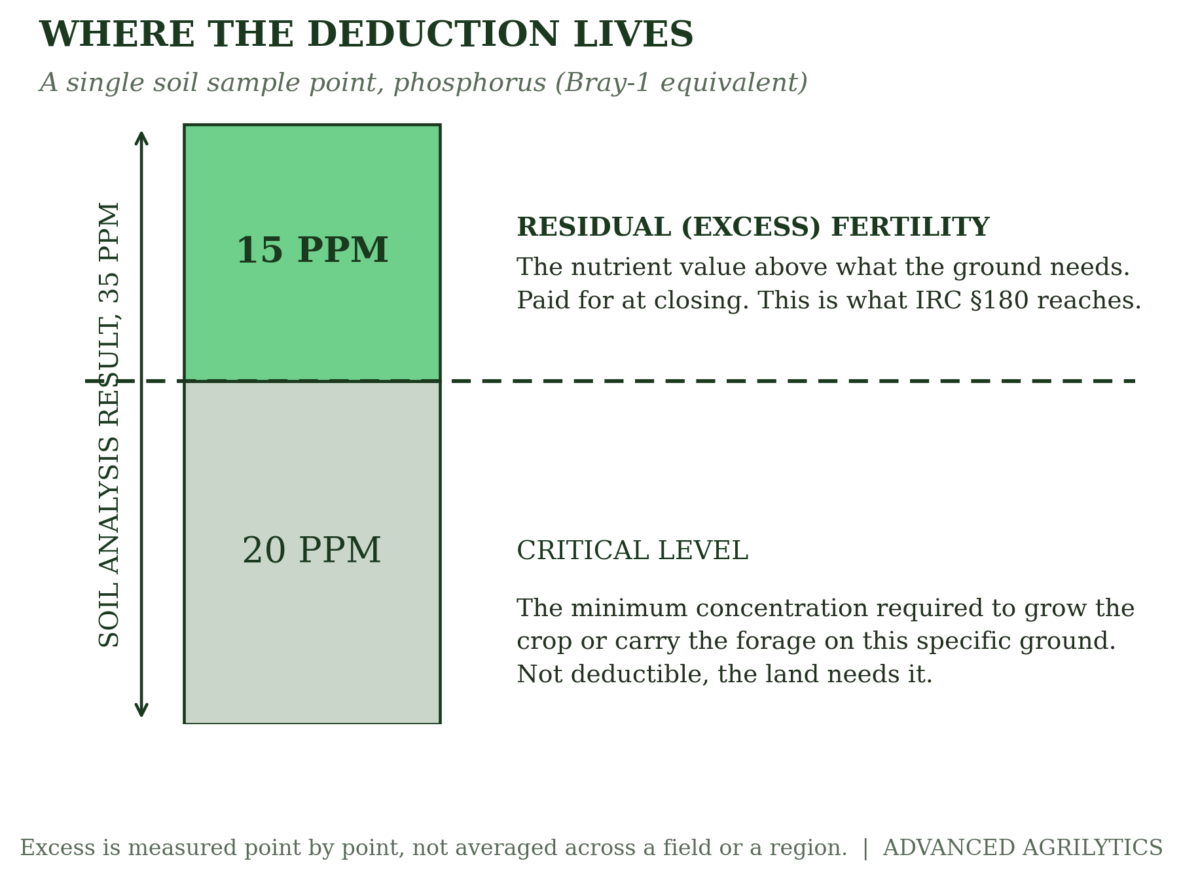
Every land transaction closes on one number. The appraisal accounts for water, improvements, access, carrying capacity, timber, and comparable sales. What it almost never itemizes is the nutrient reserve in the top six to eight inches of soil, the phosphorus, potassium, calcium, sulfur, and micronutrients a previous operator built through years of applications, and that the buyer, at closing, paid for. That reserve is not sentiment. It is a measurable, depletable input with a market price, and it behaves like a consumable asset: the crop or the forage draws it down until it is gone. Internal Revenue Code §180, on the books since 1960, recognizes that fact.
Section 180 lets a taxpayer engaged in the business of farming treat expenditures for fertilizer, lime, ground limestone, marl, and other materials that enrich, neutralize, or condition land used in farming as a deductible expense rather than a capital item. The residual fertility application extends that logic to acquisition: when farmland, ranch and pastureland supporting livestock, or production timberland changes hands, part of the price is attributable to unexhausted fertilizer the prior owner applied.
Two clarifications belong up front. “Section 180” is industry shorthand; depending on the situation the recovery may run through related provisions, and which one applies is the tax professional’s call. And this is a deduction against basis, not found money. It reduces basis in the land and is recovered as the fertility is actually exhausted by subsequent crops, commonly across three to four years, which is why it tends to favor owners who hold long term.
Properly executed, residual fertility commonly falls between $500 and more than $2,000 per acre, depending on the ground, the prior owner’s program, and the acquisition date. Take 1,000 acres at $1,000 per acre, purely for illustration: a $1,000,000 valuation, recovered across the depletion window rather than all at once, against $40,000 of valuation work at $40 per acre. Advanced Agrilytics prices it that way deliberately, tying the fee to the documentation rather than to a percentage of the deduction or of anyone’s tax savings.
One honest note that separates a description from a sales pitch: a large computed value is not automatically a large usable one. Recovery is spread across a short window and depends on the owner’s own income and circumstances, so the usable benefit has to be modeled with a CPA rather than assumed from the headline figure.
A valuation can also be performed on ground acquired years earlier. Advanced Agrilytics’ compound-specific pricing record reaches back to January 2010, a deliberate boundary rather than an arbitrary one, because a valuation that cannot be priced to the month of acquisition cannot be defended to it either.
Excess is not a loose term. It is the nutrient level above the critical level, the point at which added nutrients stop producing a yield response on that specific ground. That is not an “optimum” or a build-and-maintain target, which sit higher and exist for a different purpose. Set the critical level too high and you understate legitimate value. Set it too low, or borrow it from a county average or a published benchmark, and you manufacture value. Everything rides on that single subtraction.
The governing authority is unforgiving here. Private Letter Ruling 9211007 requires a claimant to establish the presence and extent of the residual fertilizer, show the fertility attributable to the previous owner’s applications, provide a basis to measure the increase in that land’s fertility, and define the period over which it will be exhausted. Two of those four criteria are inherently parcel-specific. A regional average describes a region, not a parcel. A benchmark carrying a land-grant university’s name fails the same way: excellent science, built to answer whether a crop will respond to fertilizer next season, not what this prior owner left in this field.
Advanced Agrilytics is a precision agronomy company servicing 1.5 million acres annually across 11 states, with 105 professionals including more than 60 agronomists and data scientists. Residual fertility valuation is not the business, it is an application of the business. That foundation drives four things a file lives or dies on
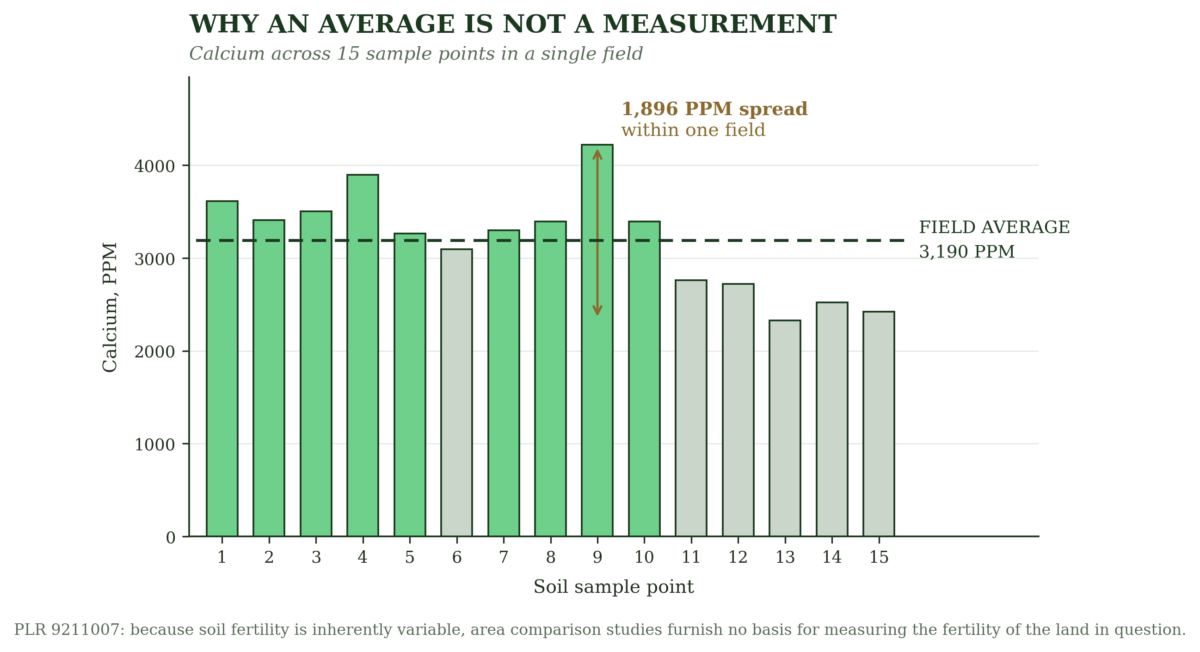
Point-level, sub-acre data. Measured values at individual points across the field, not a field average and not a handful of composited cores. This establishes presence and extent, and shows how much and where.
Field-specific critical levels. The threshold is derived from the soil characteristics measured at each point, closer to a fingerprint than a table lookup. Native and crop-required nutrients are excluded by construction.
Extraction methods reconciled first. Bray-1, Olsen, Mehlich-3, and ammonium acetate are not interchangeable, and the unit of measure does not reveal which was used. The same soil can read roughly 14 ppm of phosphorus by one method and 40 by another.
Compound-specific, date-specific pricing. Each nutrient’s excess is converted to the compound that actually delivers it and priced at that compound’s cost in the month of acquisition.
Eligibility is a real gate, and narrow descriptions of it are often wrong. The statute covers land farmed by the taxpayer or the taxpayer’s tenant, so leased ground is not automatically excluded. It also reaches ranch and pastureland sup porting livestock, where calcium is often the largest single driver of a valuation, since lime and ground limestone are named in the statute itself.
A missed soil test is not always fatal. The ideal sequence is a test after closing and before new fertilizer. Where that window was missed, acquisition-date fertility can be reconstructed by working backward from current tests, crops grown, yields removed, and inputs applied since. It carries a heavier documentation burden, and few providers do it.
The burden of proof sits with the taxpayer. There is no comprehensive regulation on point, inflated average-based valuations have begun to draw attention, and an overstated deduction carries real downside. The defensible path is narrower than the aggressive one.
You paid for the fertility. The only question is whether anyone measured it correctly enough to put a number on it that will survive a second look.
The work begins with a conversation about the property, covering acreage, the acquisition or inheritance date, and whatever soil data already exists, so scope and timing can be established. Valuation is priced at $40 per acre and includes sampling, laboratory analysis, and documentation your CPA can work from. Eligibility, timing, and treatment remain your CPA’s determination, and we coordinate directly.
Five Questions for Any Provider