Posted: Thursday, June 25, 2026
⏱ 7 minutes to read
Author: Sam Shelton, Ranch Sales | Licensed in MT
In today’s ranch market, recreation fuels a substantial amount of our sales in many regions. People seeking refuge from the large municipalities around the country have begun to acquire large tracts of land where they can hunt, hike, fish, and find serenity amongst their otherwise busy and mentally arduous daily lives. This trend of recreational purchases has become more and more popular recently, and recreational opportunity is valued more heavily than ever before. In order to rationalize these recreational purchases, buyers are also frequently looking for ways to generate income from their newly acquired oasis. This income base can come from a variety of ventures that these properties offer. These include, but are not limited to, solar and wind leases, farm production, cattle operations, and hunting leases. The question becomes, how do I get the most out of my ranch recreationally, while generating enough income to at least pay the taxes? This can be a tricky balancing act, as some of the income-producing operations can conflict with wildlife habitat and recreational opportunities. This balance can be obtained, but it takes diligence and knowledge of not only the wildlife and the operation, but the range land as well.
Grazing is one of the keystone income generators on large ranches in the West. Cattle, like elk and deer, utilize the rich range grass and water sources that these ranches provide. This can create competition between cattle and the ranches’ wildlife, not only for food and water but for privacy. As someone who is a huge proponent of the cattle industry and has been a hunting guide for years, I have spent a lot of time trying to decipher how to have the best of both worlds.
The first thing one must know is the carrying capacity of the ranch they own. Key factors that determine carrying capacity are forage production, animal needs, and grazing management. Let’s look at an example of using these factors to calculate capacity.
Let's say a ranch has 200 acres of pasture. The forage production is 3,000 lbs per acre, and the owner has a desired utilization rate of 60%. This ranch grazes cows that require 40 lbs of forage per day. I chose 80 cows arbitrarily to show how much forage would be consumed annually. I also included how many cows a person could run for one month at that stocking rate.
Here are the formulas you’d utilize to calculate AUMs.
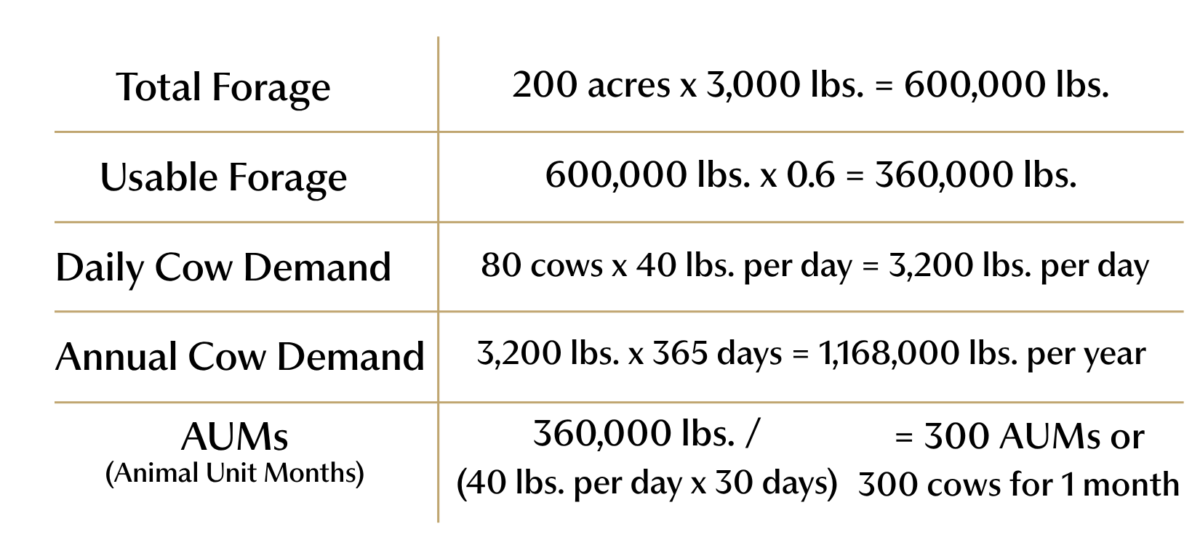
Once this number is understood, the first step is to stock your ranch with enough cows to pay the bills but not too many as to disrupt the natural flow of the wildlife. A stocking rate of 60% is what I have found to be the best number for this symbiotic relationship. The next thing to be considered is pasture rotation and cow density in each pasture. Spreading the 60% capacity out over all the pastures creates less pasture density and leaves each pasture more intact for the wildlife. More frequent rotation also aids in the regeneration of each pasture and helps preserve freshwater sources as well.
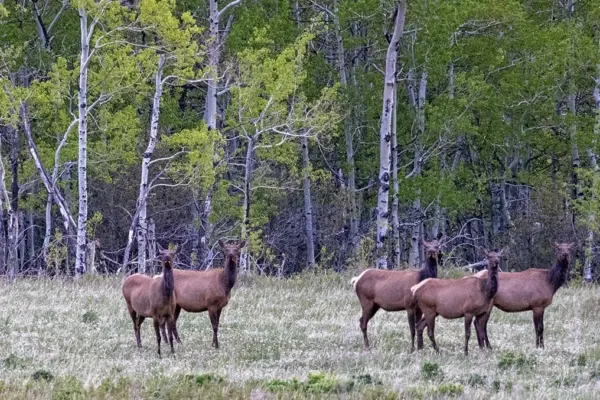
Game species such as elk and deer will naturally avoid cattle, especially on water sources, so keeping the pastures most frequented by elk and deer free of cows or at least lightly stocked helps keep them around. This low stocking rate also helps the cattle as they have less competition from other cattle and can get limitless nutrients and fresh water.
The next major part of the equation is farming. Most large operations have a hay base to support their herd, along with some other supplemental crops such as grain and corn. These crop fields are huge attractants for deer and elk. In order to harvest enough to feed your cows but maintain your food accessibility for wildlife, there is one major strategic play that helps stabilize both. I have seen success by keeping a couple of food plots fenced to keep the cows out while simultaneously leaving the crop standing, meaning not harvesting the food plots. The rest of the farm ground can be harvested, baled, and fed during the winter months. Come hunting season, things can be adjusted even more, involving pastures. The type of crop that is planted in your food plots can help maximize their effectiveness as well. Elk and Deer seem to key on crops such as alfalfa, sainfoin, wheat, and corn. The type of crop planted will partially be determined by the region in which the ranch is located and the availability of water. If in a dryer climate without access to irrigation, I have seen the best success with sainfoin, wheat, and alfalfa. If irrigation is available, corn and irrigated alfalfa seem to be some of the better attractants for elk and deer.
It’s best to use trail cameras to find where on the ranch the elk and deer seem to be frequenting the most. Once this information is gathered, a person can concentrate the cattle in the pastures with the least activity, creating a sanctuary amongst the other pastures for the deer and elk. It would also be prudent to clean up the water sources in those sanctuary pastures to ensure a good, clear water source for the wildlife.
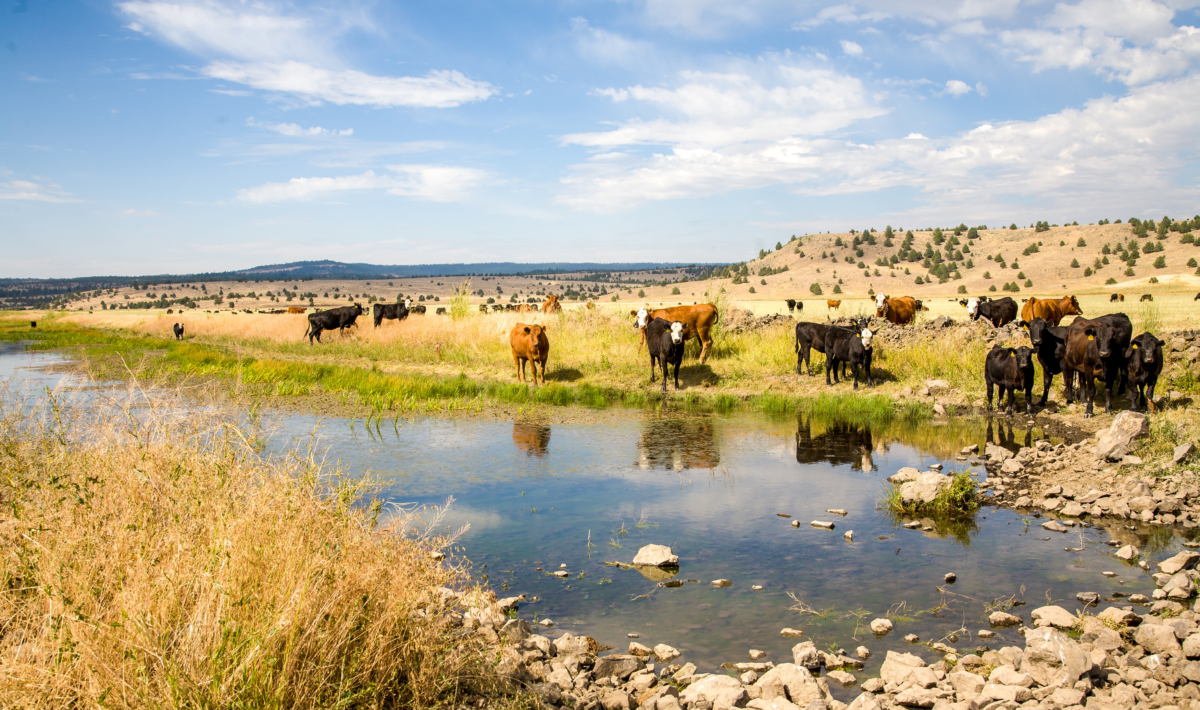
Water is one of the most important features for holding wildlife on a ranch and maximizing its productivity. The first thing an owner can do is develop all the springs on the ranch and get them producing good, clean water. Tanks can be put at these springs to hold water for stock and wildlife. Wallows or small ponds can also be dug in at these locations to create more of a natural-looking water source. In dry climates, wells can be punched and tanks can be filled to ensure the availability of water for wildlife and for stock.
Having cows outside of the pastures where your quarry resides the most not only saves feed, water, and cover, but it also limits the agricultural activity in those pastures during hunting season. The workers involved in the ag operation need to conduct their duties and will be in those pastures working and doctoring. This activity is necessary, but it is helpful to keep it limited to the areas where you are not hunting.
Another common income source amongst agricultural properties is renewable energy leases, most commonly wind or solar. Wind or solar farms can be strategically placed on your ranch to avoid interfering with livestock or wildlife while generating income via the lease payments from private companies. These lease payments can vary, but some common structures include per turbine payments, royalties incumbent upon production, or both. Per-turbine lease payments are often dependent on the turbine size and are typically $5,000-$8,000 per megawatt. The royalties are paid on a percentage basis and are usually 4-10% of the revenue generated. Solar leases are usually paid on a per-acre basis and range from $700-$2,000 per acre per year. Both wind and solar are just one more tool to maximize a ranch's potential.
Agriculture is a pivotal part of all the iconic ranches in the country and is crucial to fueling the economy in our nation. Finding the balance between work and play on your ranch can be tedious, but with some knowledge and proper planning, the two can coexist in perfect harmony. If you’re exploring how to align your ranch’s recreational potential with income-producing strategies, feel free to reach out to discuss how these principles might apply to your property.